Program Notes
Thank you for coming tonight’s program. This concert features solo works for “accessory” percussion instruments. You’ve likely heard many of them before, but tonight all the “small” things take center stage.
Windward (2018) – David Bithell
“Windward is a composition for bass drum, interactive animation, electronic sound, and controlled lighting. Using the head of a concert bass drum as a projection screen, the performer conjures dynamic images and sounds through their musical gestures. Structured as a series of expanding vignettes, sections of musical exploration alternate with visually narrative sections. As the work unfolds, these visual creations begin to take on a life of their own – even questioning the authority of their maker. The work is a technologically driven meditation on storytelling and the power of myth.” – David Bithell
Silver Streetcar for the Orchestra (1988) – Alvin Lucier
Alvin Lucier (1931–2021) was an American experimental composer and referred to by some as a “sound artist.” His compositional portfolio focused on exploring the physical properties of sound, acoustics, and even the human mind.
Some regard the triangle as both a simple shape and an easy percussion instrument to play. If one explores the nuances and intricacies of its vast spectrum of sound, they can quickly realize how much this three-sided metallic instrument can offer the ears of both performers and audiences.
To best enjoy this process-oriented work, I find it helpful as a listener to close my eyes and let the sounds “be”. Oh… and ignore the rhythm… 😅
A Cool Gadget (2018) – Casey Cangelosi
Regarded as the “Paganini of Percussion,” Casey Cangelosi’s reputation as a composer is just as equally revered.
In addition to the technical demands of his works, the “tape” parts of his works feature altered and even humorous sounds of children’s electronic toys (e.g., Speak & Spell).
Tonight’s “cool gadget” is the tambourine, a common member of the percussion section in the orchestra. The work utilizes conventional performance techniques (e.g., normal strikes, playing between the knee and hand, finger rolls, shake rolls, soft playing on the leg / knee), but also incorporates some other elements that maximizes nearly all available sounds that the instrument offers.
INTERMISSION
(please feel free to leave the hall and stretch your legs while we do a set change)
(the second half will be one continuous “act.” You are welcome to applaud, but I will not be taking any bows)
Temazcal (1984) – Javier Alvarez
***WARNING*** – This piece will include video projection and that may affect photosensitive viewers. If you need to avert your eyes or leave the hall, please do so. I will not be offended in anyway
Javier Alvarez (1956–2023) was a Mexican born composer who blended international musical traditions with new music technologies. Born in Mexico City, Alvarez took his musical and cultural heritage to the U.S. and the U.K. where he studied composition and experimented with technology to create several works for instruments and “tape.”
Temazcal (1984), a combination of the Nahuatl words for “vapor” and “house,” is inspired by and refers to the Mesoamerican ritual of entering into a sweat lodge for physical, emotional, and spiritual cleansing.
The source material for the electronic media is from a traditional Mexican folk song performed on harp that Alvarez recorded… what you hear in the last 60 seconds of the piece was manipulated into ominous and other worldly sounds that exist from the very beginning of the piece; “burning water,” static electricity, alien spaceships / tractor beams, techno / EDM beats, etc.
In order to enhance my take on the electronic accompaniment, I created a video element. Using the open source program, DaVinci Resolve, I took simple colors, effects filters, images from Death Valley, and other things to try and visually illustrate my journey through Alvarez’s soundscape.
For the performer, Alvarez provides a “map” of realization; the composer provides patterns that can used throughout the work, but encourages the performer to explore possibilities of interchanging and embellishing on these patterns to find their own “journey” through the electronic landscape.
I do not consider myself and maraca virtuoso or digital artist by any means, but have discovered my own journey through the instrument, the curated media, and the physical, spiritual, and sometimes emotional demand that this piece elicits from me.
Having Never Written A Note for Percussion (1971) – James Tenney
***WARNING*** – This piece has the capacity to be “too loud” for listeners. If you need to plug your ears at any point, please do so.
James Tenney was known for his minimal approach to music composition; tonight’s work is one from his “Postal” series, where the entire musical score was written on the back of a postcard.
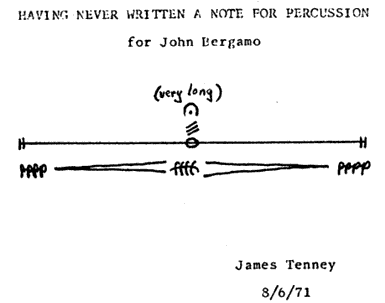
Enough said…
The Big Audition (2015) – Casey Cangelosi
Preparations. Applications. Pressure. Anxiety. In the pursuit of “perfection.”
Auditions can be nerve wracking for musicians; playing in front of strangers in hopes of winning a job or making an ensemble, having every gesture, note, sound, etc. critically evaluated by professional musicians.
This piece for solo crash cymbals and “tape” takes the performer through their “big audition.” You’ll hear me play along with some standard audition excerpts, funky electronic sounds, and “interact” with an incessant hyper-critical French woman… let’s call her Mademoiselle Marie.
Will I win the job? Will I suffer humiliation? Guess you’ll have to wait and see…
 Boyce Jeffries